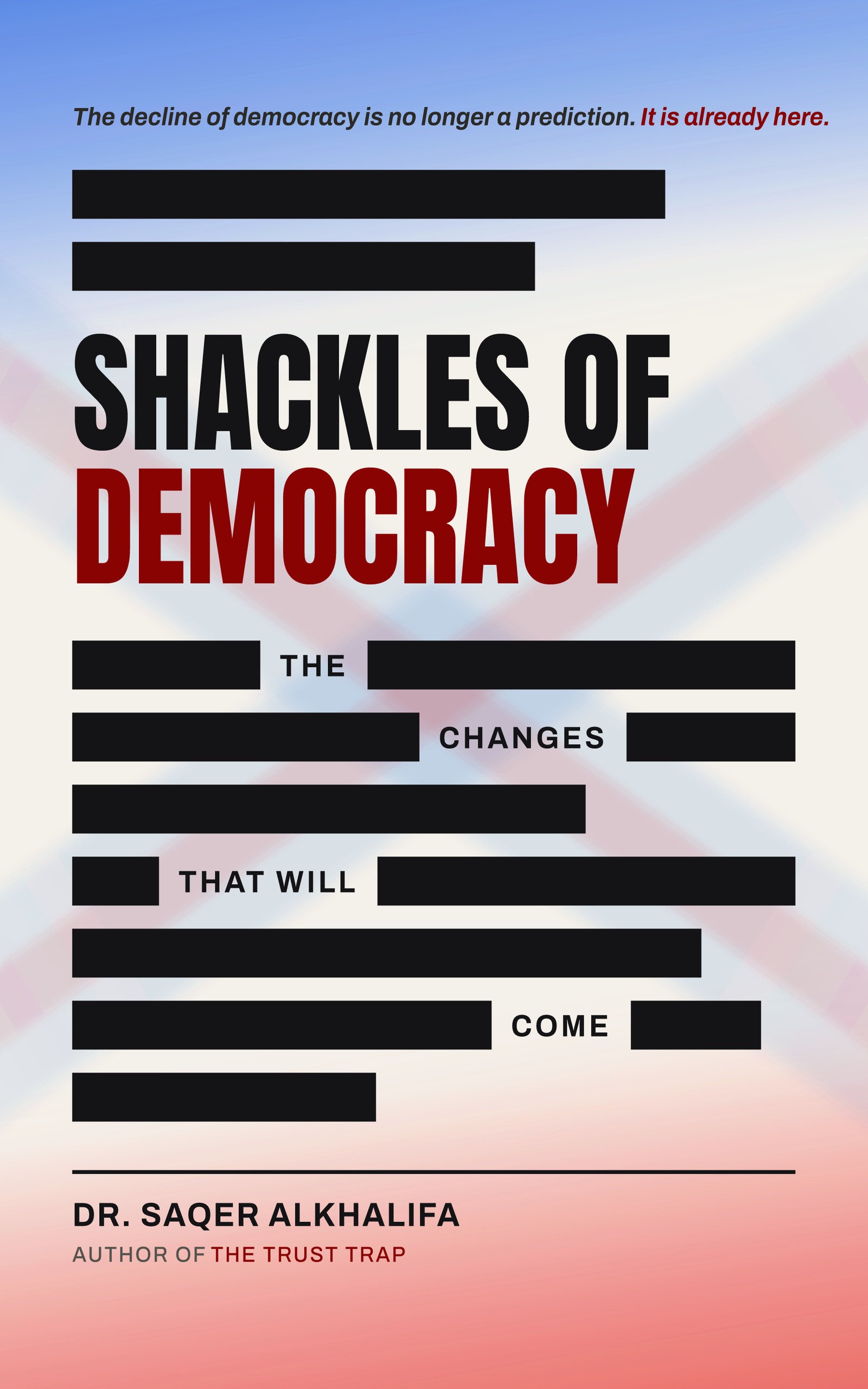
Shackles of Democracy
Why democracies will deceive their people to survive the century.
The decline of democracy is real, measurable, and accelerating. Its deepest cause is internal. Every claim rests on public data, and the final chapter states exactly what would have to happen for the argument to fail.
Why shackles? Because democracy has become chained not by an outside jailer but to itself, weighed down by its own contradictions at exactly the moment the race demands it run free. The shackles are not on the people. They are on the system.
Dr. Saqer AlKhalifa · Author of The Trust Trap
Youth Compass: the free app for young people in the Gulf.
Everything free for young people on this site, in one app: the Youth Compass assessment, every major explained, verified internships, a first CV, the gig board, and the new board for ideas seeking investors. It works offline, and there is no account and no charge.
بوصلة الشباب: تطبيق واحد مجاني يجمع بوصلة الشباب وفرص التدريب والأعمال القصيرة والسيرة الذاتية ولوحة الأفكار الباحثة عن مستثمرين، بالعربية والإنجليزية.
On iPhone: open in Safari, then Share, then Add to Home Screen. On Android: Chrome offers Install app. It then works like any app, even offline.
“A timely exploration of a topic challenging the world right now. Thought-provoking, with excellent examples and relevant research provided by the author. The writing is top-notch as well.”
Gary Saxton, former US Army officer and technology executiveAuthor of 100 Marathons After 50: A Runner’s Journey of Discovery, Performance, and Growth

Presented to His Royal Highness Prince Turki Alfaisal AlSaud
It was an honor and a privilege to present a copy of Shackles of Democracy to His Royal Highness Prince Turki Alfaisal AlSaud in August 2026.
The data behind the book.
“I would rather be checked than believed.”, Appendix A
The ballot was never the destination. It was the detour.
For a century we have been told that democracy is the end of history, the final, unimprovable form of government. Shackles of Democracy argues the opposite: the machinery of mass elections is failing on its own terms, and this century will finish the job.
Drawing on political history, institutional decay, and the technologies now rewriting how consent is manufactured, the book shows how the vote became a ritual that constrains citizens more than it empowers them, and why the systems replacing it are already taking shape.
Confrontational, rigorous, and unafraid of its own conclusions, it does not mourn the ballot. It asks the harder question: what should come after?
“The decline is already measurable.”
Not a prediction, a trend line. Built from Freedom House, V-Dem, the World Bank, and the sources named in the text.
“The century rewards almost everything democracy is worst at.”
Speed, secrecy, and long horizons, and it punishes almost everything democracy was built to do.
“A competition for power wearing the costume of public service.”
How elections stopped selecting for governing and started selecting for winning.
The second half designs what should come after. And the final chapter tells you exactly how to prove the whole argument wrong.
What readers are saying.
“In many places I felt as though you were reading the arguments and objections forming in my own mind, then arriving at them before me, putting them in front of me, and answering them before I had reached my own verdict on what I was reading.”
“A very strong book as a deep diagnosis and an intellectual provocation, and not a piece of advocacy that opposes democracy for the sake of opposing it. You set out the objections that could threaten your own argument, you reported the statistical results that came back empty or fragile, and you did not hide that the data supported some hypotheses more than others.”
Abdulla Al ArabiSent by email on 1 September 2026, in reply to a request for a frank opinion. His reservation is that many public decisions carry technical knowledge and value choices at the same time, so the mechanism that decides what counts as technical, and who holds the authority to decide it, needs more detail before the proposed system is complete.
Translated from Arabic. The original is on the Arabic page.
“What gives the argument its exceptional weight is the author’s own experience and his academic years in the West. The reader feels he is looking at a diagnosis from inside the centre rather than from the margin of abstract theory.”
“The strength of the book is its nerve in confronting the reader who believes in the ideal of systems driven by the street, and in unsettling those convictions. It cuts through to a hard realism, showing how street pressure and short term calculation at the ballot box become brakes that stall the strategic decisions a state’s fate depends on.”
Jumana AlnasriLaw student at Sultan Qaboos University in Oman, published on LinkedIn on 1 September 2026. She closes with three constitutional questions: how law can protect the major strategic projects of a state from cancellation with every new political cycle, where the power of the executive to restrict transparency during a crisis legally stops, and whether revising constitutions for speed strengthens the state or begins to undermine the legitimacy of the political order itself.
Translated from Arabic. The original is on the Arabic page.
All three editions are available now.
Paperback and hardcover ship from Amazon. Other retailers and ebook stores
Read the first chapter.
The introduction and Chapter One, twenty-two pages, sent straight to you. Decide for yourself whether the argument holds before you spend anything.


No list, no follow up unless you ask for one.
Get it where you read
United States · amazon.com
United Kingdom · amazon.co.uk
Other retailers and ebook stores
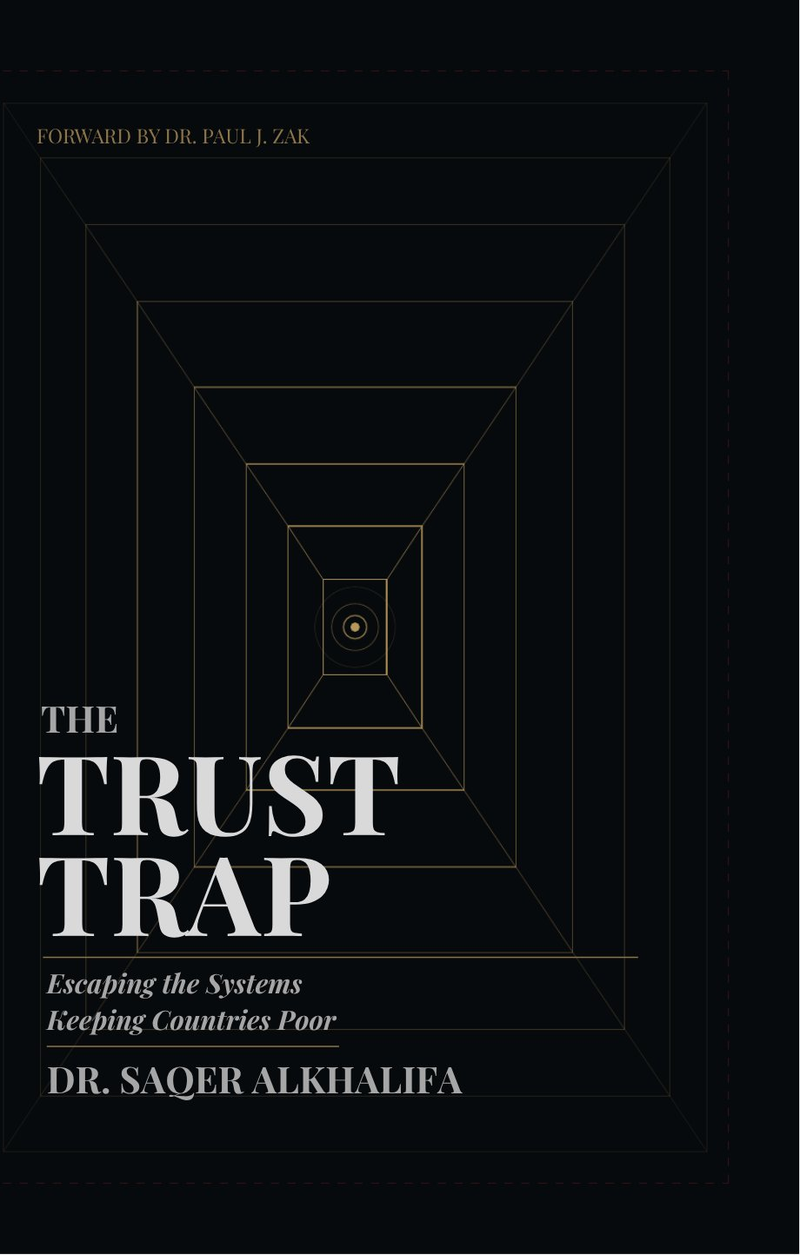
The Trust Trap: Escaping the Systems Keeping Countries Poor
Where Shackles diagnoses the failure, The Trust Trap builds the alternative: trust as a measurable, engineerable system outcome, with case studies from Bahrain, Rwanda, Finland, Estonia, Japan, and the United States.
Free tools for students choosing a university major.
Most students in the Gulf choose a degree on rumour. Youth Compass is five free tools, in Arabic and English, that show a student what actually fits them, whether a university will take them, and who will pay for it.
بوصلة الشباب: خمس أدوات مجانية بالعربية والإنجليزية لطلبة الخليج
The full interview on WHO YOU ARE
An hour on why the advice to follow your dreams fails most people, what a diabetes diagnosis at 28 changed, and the reason I chose political science at seventeen.
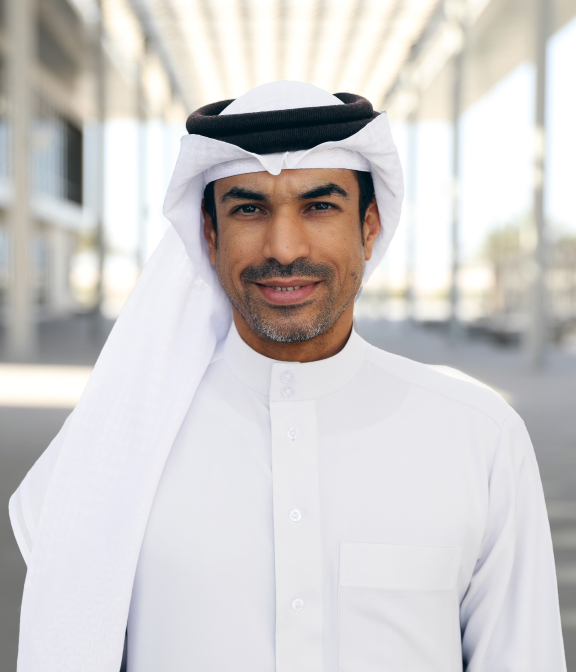
Two decades inside the systems he writes about.
Dr. Saqer AlKhalifa holds a Ph.D. in Political Science from Claremont Graduate University and an M.A. from The American University in Washington, D.C. He is a senior advisor at Bahrain’s Ministry of Education and a professor at the American University of Bahrain. A published scholar and international speaker, he has spent over two decades designing reforms across education, sport governance, and youth development.
أغلال الديمقراطية
The full Arabic edition, translated from the latest English text. Now in paperback and Kindle. One link, every store
Bringing the argument to your stage
- Why Nations Fail, and What to Do About It
- Building Trust-Based Institutions from the Ground Up
- The Science of Trust in Leadership and Policy
- Does Democracy Have a Future?

